Chromium trichloride

CrCl₃

Also called chromium(III) chloride

van der Waals crystal magnet

The chlorine member of the chromium trihalides, and the odd one out: its magnetic moments lie in the plane instead of pointing out of it. Each layer orders ferromagnetically by 17 K, and below 14 K the layers lock in opposite directions. Grown as a single layer on graphene it is a ferromagnet of the two-dimensional XY kind – the textbook case of spins confined to a plane. Thin flakes also show how stacking shapes magnetism: they skip the stacking change of bulk crystals and couple their layers about ten times more strongly. And unlike CrI3, its bulk crystals are stable in air and exfoliate easily.

What it looks like

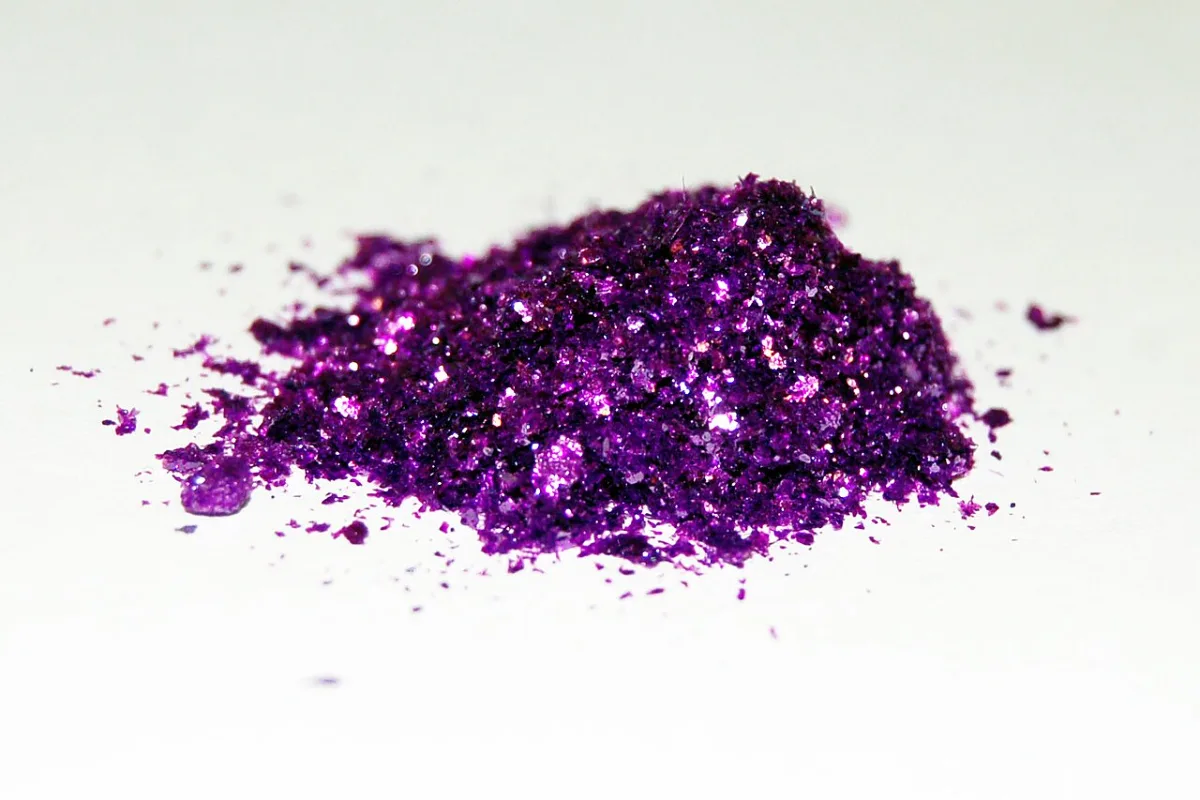
A small heap of glittering violet flakes on a white surface.
Chromium(III) chloride, CrCl3, as sold for the laboratory. It comes as thin, glittering flakes because its crystals split so easily between their layers. Image: Ben Mills, public domain; resized.

Key properties

  • Magnetic order in two steps in bulk crystals: ferromagnetic correlations within the layers by 17 K, antiferromagnetic order between them below 14 K
  • Its moments lie in the plane, unlike those of CrI3 and CrBr3
  • Atomically thin flakes stay antiferromagnetic between layers down to the bilayer, with their moments in the plane and no preferred direction within it
  • A monolayer grown by molecular beam epitaxy on graphene is a ferromagnet with the critical behaviour of the 2D-XY class
  • In few-layer flakes the exchange between layers is about ten times stronger than in bulk, and Raman spectra show that the flakes skip the bulk crystals’ stacking transition
  • Tunnelling conductance maps the magnetic phase diagram layer by layer: a spin-flip transition at high field for every thickness and, in in-plane fields, a spin-flop near zero field for even numbers of layers but at finite field for odd ones

How it is made

  • Bulk crystals by chemical vapour transport from 800 to 600 °C, which also purifies commercial CrCl3
  • Short chemical vapour transport straight onto yttria-stabilised zirconia, from 600 to 500 °C: sheets at most 25 nm thick, which ultrasonic delamination takes down to monolayers
  • Mechanical exfoliation of bulk crystals down to monolayers
  • Molecular beam epitaxy of monolayers on graphene

Uses, and how close they are

Readiness runs lab → prototype → pilot → deployed.

Open problems

  1. Does a single layer show a true Berezinskii–Kosterlitz–Thouless transition, and how far does its small in-plane anisotropy cut it short?
  2. Why is the exchange between layers ten times stronger in thin flakes – is the different stacking the whole story?

All 256 open problems on Flatland, by theme

Going deeper

Short notes for specialists. Choose a lens in the header and yours comes first.

For theoreticians · your lens

The XY member of the family: moments in the plane with only a small anisotropy, so a monolayer is the natural material for Berezinskii–Kosterlitz–Thouless physics, and in multilayers shape anisotropy outweighs the small magnetocrystalline term. Calculations reproduce the bulk structure only when magnetism is included, and van der Waals functionals find several nearly degenerate stackings and magnetic structures – consistent with thin flakes settling on a different stacking. Many-body perturbation theory gives exciton binding energies of up to 3 eV in a monolayer and about 2 eV in bulk, with an optical gap that barely depends on thickness.

For experimentalists · your lens

The two magnetic transitions show up as anomalies in the heat capacity at 14 and 17 K. In thin flakes, tunnelling magnetoconductance follows the spin-flip and spin-flop transitions, with an even–odd effect in the number of layers, and polarisation-resolved Raman spectroscopy shows whether the bulk stacking transition has happened. Monolayers grown on graphene are studied by X-ray magnetic circular dichroism.

For engineers · your lens

Ordering below 20 K rules out applications at practical temperatures. CrCl3 is valued as an air-stable, easily exfoliated magnetic insulator for heterostructure research, and as a tunnel barrier whose resistance tracks its magnetic state.

In the research tracks

Recent news

The newest items tagged CrCl3, from the news feed updated 22 Oct 2026.

Preprintnot yet peer reviewed arXiv

Studying the evolution of exchange and dipolar interactions and spin correlation in vdW magnet CrCl3 across magnetic phases

Understanding quantum interactions in van der Waals magnets are critical to realizing their potential for next-generation magnetic, electronic, and spintronic applications. In this study, we investigated the evolution of exchange and dipole-dipole interactions in van der Waals magnet CrCl3 using multifrequency…

ExperimentCrCl₃
Preprintnot yet peer reviewed arXiv

Noncollinear spin textures and 90° domain walls in twisted XY magnets

Twisted moiré magnets are promising in exploring noncollinear magnetic phases, yet current experimental studies have been restricted to uniaxial magnets, limiting the accessible phase space. Here, we demonstrate noncollinear moiré magnetism based on XY magnet CrCl3. The tunneling magnetoconductance of twisted CrCl3…

TheoryCrCl₃

All 11 items tagged CrCl₃ in the news feed  ·  RSS feed for CrCl₃

Key references

  1. Magnetic behavior and spin-lattice coupling in cleavable van der Waals layered CrCl3 crystalsMcGuire et al. · Physical Review Materials 1, 014001 (2017)doi:10.1103/PhysRevMaterials.1.014001
  2. Enhancement of interlayer exchange in an ultrathin two-dimensional magnetKlein et al. · Nature Physics 15, 1255 (2019)doi:10.1038/s41567-019-0651-0
  3. Determining the phase diagram of atomically thin layered antiferromagnet CrCl3Wang et al. · Nature Nanotechnology 14, 1116 (2019)doi:10.1038/s41565-019-0565-0
  4. Atomically thin CrCl3: an in-plane layered antiferromagnetic insulatorCai et al. · Nano Letters 19, 3993 (2019)doi:10.1021/acs.nanolett.9b01317
  5. Intrinsic 2D-XY ferromagnetism in a van der Waals monolayerBedoya-Pinto et al. · Science 374, 616 (2021)cited by 251doi:10.1126/science.abd5146
  6. Evolution of interlayer and intralayer magnetism in three atomically thin chromium trihalidesKim et al. · PNAS 116, 11131 (2019)doi:10.1073/pnas.1902100116
  7. Chromium trihalides CrX3 (X = Cl, Br, I): direct deposition of micro- and nanosheets on substrates by chemical vapor transportGrönke et al. · Advanced Materials Interfaces 6, 1901410 (2019)cited by 60doi:10.1002/admi.201901410
  8. Quasiparticle energies and excitonic effects of chromium trichloride: from two dimensions to bulkZhu and Yang · Physical Review B 101, 245401 (2020)doi:10.1103/PhysRevB.101.245401
  9. Synthesis, nanocrystal deposition and characterization of 2D transition metal trihalide solid solutionsFroeschke · Doctoral thesis, TU Dresden (2023)

Download these references as BibTeX or RIS for Zotero, EndNote or Mendeley.