MXenes
Mₙ₊₁XₙTₓ (M = early transition metal; X = C and/or N; Tₓ = surface terminations such as –O, –OH, –F, –Cl; n = 1–4)Also called Ti₃C₂Tₓ, Ti₂CTₓ, Nb₂CTₓ, V₂CTₓ, Mo₂CTₓ, 2D transition metal carbides and nitrides
A large family of metallic 2D materials made by chemically dissolving one layer out of a ceramic. Unlike most metals they disperse in water and can be sprayed, printed or painted like ink, while still conducting almost as well as a metal film. That combination has made them leading candidates for electromagnetic shielding, flexible electrodes and fast energy storage. Several dozen compositions have been made so far.
Crystal structure
They are coordination polyhedra. Only complete ones are drawn.
Three Ti3C2 layers as they sit in the parent MAX phase Ti3AlC2, with the aluminium planes between them left out: each layer is turned by 180° against the one below, c = 18.58 Å. Etching out the aluminium, adding surface terminations and letting in water push real multilayer Ti3C2Tx further apart, by an amount that depends on how it was made. Stacking of Ti3AlC2 (space group P63/mmc), with c = 18.578 Å from Tzenov and Barsoum, Journal of the American Ceramic Society 83, 825 (2000).
- Ti
- C
- Cell
- Hexagonal, a = 3.08 Å
- Atoms per cell
- 5
- Ti–C bonds
- 2.08 and 2.20 Å
- Height
- 4.74 Å between the outer atom centres
They are coordination polyhedra. Only complete ones are drawn.
Three Ti4N3 layers as they sit in the parent MAX phase Ti4AlN3, with the aluminium planes between them left out: each layer is turned by 180° against the one below, c = 23.40 Å. Stacking of Ti4AlN3 (space group P63/mmc) from Rawn and colleagues, Materials Research Bulletin 35, 1785 (2000); COD 1526338.
- Ti
- N
- Cell
- Hexagonal, a = 2.99 Å
- Atoms per cell
- 7
- Ti–N bonds
- 2.08–2.14 Å
- Height
- 7.24 Å between the outer atom centres
What it looks like
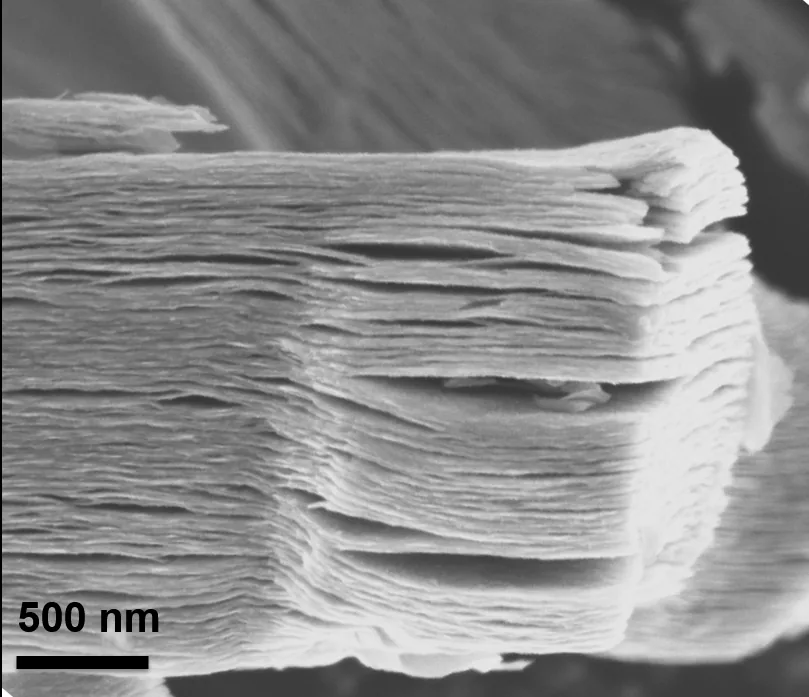

Key properties
- Electrical conductivity of the best Ti3C2Tx films in the range of ~15,000–20,000 S/cm – exceptional for a solution-processed material
- A 45-µm Ti3C2Tx film blocks ~92 dB of electromagnetic radiation
- Volumetric capacitance of ~900 F/cm3 in a Ti3C2Tx ‘clay’ electrode in sulfuric acid
- Hydrophilic surfaces give stable aqueous dispersions without surfactants
- Surface terminations set work function, conductivity, hydrophilicity and oxidation resistance
How it is made
- Selective etching of aluminium from a MAX phase such as Ti3AlC2 in concentrated HF – the original 2011 route
- In-situ HF generation with LiF and HCl – larger flakes that delaminate spontaneously into single layers
- Lewis-acid molten-salt etching (e.g. CuCl2, ZnCl2) – fluorine-free, chlorine-terminated MXenes
- Electrochemical or hot-alkali etching – fluorine-free, with lower yields
- Delamination by intercalating ions or molecules (Li+, TBAOH, DMSO) followed by shaking or sonication
- CVD growth of Mo2C crystals – termination-free sheets used for superconductivity studies
Uses, and how close they are
- Electromagnetic interference shielding and antennasprototype
- Supercapacitor and battery electrodesprototype
- Conductive inks, textiles and flexible electronicsprototype
- Electrocatalysis, sensors and water treatmentlab
Readiness runs lab → prototype → pilot → deployed.
Open problems
- Can terminations be controlled uniformly, instead of the mixed –O/–OH/–F surfaces most etches produce?
- Can fluorine-free, scalable synthesis match the flake quality of HF and LiF–HCl routes?
- What limits oxidation stability, and can water-based inks reach shelf lives of years?
- Which of the many predicted compositions are synthetically accessible, and are any of them semiconductors in practice?
Going deeper
Short notes for specialists. Choose a lens in the header and yours comes first.
Terminations dominate: computed band structures, work functions (predicted to span several electronvolts across termination chemistries) and magnetic ground states all depend on which groups sit where, and real surfaces are mixed – use special quasirandom structures or cluster expansions rather than a single idealised termination. DFT+U choices matter for Cr-, V- and Mn-based MXenes predicted to be magnetic. Intercalated ions and confined water must be included to model capacitance.
Confirm etching by XRD: the MAX-phase (002) reflection near 9.5° 2θ disappears and the MXene (002) moves to lower angles (~6–7°) as terminations and intercalants expand the spacing. Quantify terminations by XPS and, where possible, NMR; check residual aluminium by EDS; report flake-size statistics and film conductivity with thickness. Store dispersions cold, dark and deoxygenated, and state their age when measured.
Among the most process-friendly 2D materials: water-based inks suit spray, blade and printing methods already used in industry. The obstacles are fluoride chemistry (safety and waste), batch-to-batch variation in terminations and flake size, MAX-phase precursor supply, and oxidation during storage and use.
In the research tracks
Growth methods
Recent news
The newest items tagged MXenes, from the news feed updated 5 Oct 2026.
All 88 items tagged MXenes in the news feed · RSS feed for MXenes
Key references
- Two-dimensional nanocrystals produced by exfoliation of Ti3AlC2cited by 11,886doi:10.1002/adma.201102306
- Conductive two-dimensional titanium carbide ‘clay’ with high volumetric capacitancecited by 6,028doi:10.1038/nature13970
- Electromagnetic interference shielding with 2D transition metal carbides (MXenes)cited by 5,242doi:10.1126/science.aag2421
- 2D metal carbides and nitrides (MXenes) for energy storagecited by 7,489doi:10.1038/natrevmats.2016.98